

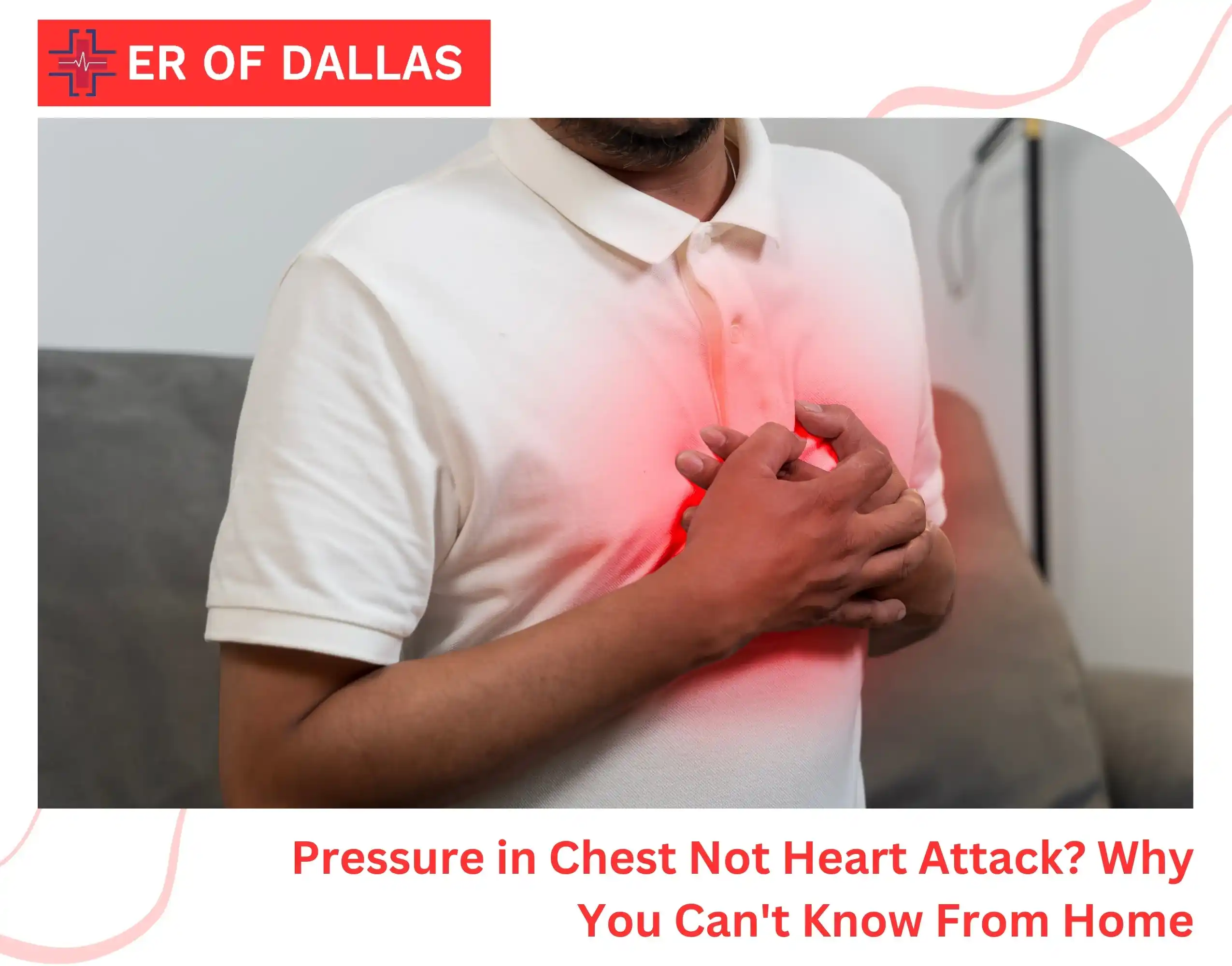
If you searched for “pressure in chest not heart attack,” you’re probably hoping for reassurance. You’re feeling something in your chest — pressure, tightness, a heaviness, an ache — and you’re trying to find a list of non-cardiac causes that explain it so you don’t have to go to the ER. We understand that impulse. We also have to be honest with you, because this is the kind of decision that can save or cost a life.
Yes — there are many causes of chest pressure that aren’t heart attacks. Anxiety, muscle strain, acid reflux, costochondritis, gallbladder issues, lung conditions. Many people who come to our ER with chest pressure go home with a non-cardiac diagnosis and significant relief.
But here’s the truth no article should hide from you: you cannot tell the difference between cardiac and non-cardiac chest pressure from your couch. Neither can your spouse. Neither can a symptom checker. Even emergency physicians can’t tell without an EKG and blood work. Heart attacks frequently present without crushing chest pain — especially in women, diabetics, and older adults — and the symptoms that look most like “definitely not a heart attack” can actually be exactly that.
This article explains why, walks through the heart attack warning signs people miss, describes how an ER actually rules cardiac causes in or out (typically in under an hour), and only then talks about common non-cardiac causes. The goal is to help you make a safe decision — and if you’re symptomatic right now, the safe decision is almost always to come in.
🚨 When to Call 911 Right Now
If you’re experiencing chest pressure right now, call 911 immediately if any of these apply to you:
- Chest pressure or pain that radiates to your jaw, neck, shoulder, arm (especially the left), or back
- Chest pressure with shortness of breath, sweating, nausea, lightheadedness, or feeling faint
- Chest pressure that lasts more than 10–15 minutes
- Chest pressure that began with exertion, even if it has eased
- Sudden onset, severe chest pressure or a feeling of “an elephant on my chest”
- Pressure combined with a sense of impending doom or that “something is very wrong”
- Any chest symptoms in someone with known heart disease, diabetes, high blood pressure, smoking history, or family history of early heart attack
- Chest symptoms in someone who has recently had surgery, long travel, immobility, hormone use, or cancer (could be pulmonary embolism)
- Chest pain with weakness or numbness on one side, slurred speech, or facial droop (call 911 for stroke routing)
- Coughing up blood
- Loss of consciousness, even briefly
Calling 911 is the right move even if you’re wrong. EMS can do an EKG in the field, transmit it to the receiving hospital, and route to a cardiac center if needed. The minutes saved by riding instead of driving — or sitting at home Googling — can be the difference between full recovery and permanent heart damage. Aspirin (chewed, 325 mg) is generally safe to take while waiting for EMS unless you’re allergic or have been told not to.
Why You Can’t Rule Out a Heart Attack From Home

Here’s what most online articles won’t tell you directly. The features people use to convince themselves “it’s not a heart attack” are unreliable. Specifically:
“It’s pressure, not sharp pain — must not be cardiac.” False. Heart attacks classically cause pressure or heaviness, NOT sharp stabbing pain. Pressure is actually one of the most common heart attack presentations.
“It’s on the right side, not the left — must not be cardiac.” False. Heart pain can be central, right-sided, or radiate anywhere in the chest, jaw, neck, back, or arms.
“It comes and goes — must not be cardiac.” False. Stable angina (warning sign of underlying heart disease) and unstable angina (warning sign of imminent heart attack) both come and go. Cardiac chest pain is often intermittent.
“I can press on it and it hurts — must be muscular.” Less false, but not reliable. Reproducible chest wall pain is more likely to be muscular, but it does not rule out cardiac causes. About 1 in 7 patients with chest wall tenderness still have a serious cardiac issue.
“It feels like heartburn / it goes away with antacids — must be acid reflux.” Dangerous assumption. Cardiac chest pain often mimics indigestion exactly, and many people having a heart attack report relief from antacids or Tums (which is a real placebo or coincidence). Self-treating with antacids and waiting can be fatal.
“I’m too young.” False sense of security. Heart attacks in patients under 40 are increasing, and risk factors like obesity, diabetes, smoking, cocaine use, and family history change the calculation. We see heart attacks in people in their 30s regularly.
“I’m a woman.” This is one of the most dangerous misconceptions. Women have heart attacks too. Their symptoms are often different from the classic male presentation — and they’re more likely to delay seeking care because of this exact reasoning. See the next section.
Silent and Atypical Heart Attacks — What Searchers Miss
Up to half of all heart attacks are “silent” or atypical — meaning the patient doesn’t experience the Hollywood version (sudden crushing chest pain, clutching the chest, collapsing). Instead, they have symptoms that they — and sometimes their doctors — easily attribute to something else.
Atypical heart attack presentations include:
- Chest pressure (not pain) that feels like a tight band, heavy weight, or squeezing
- Shortness of breath without chest pain
- Pain or discomfort in the jaw, neck, back, or one or both arms
- Unusual fatigue — feeling unusually tired for days before the event
- Nausea, indigestion, or upper abdominal discomfort
- Lightheadedness or feeling faint
- Cold sweats
- Anxiety or a sense of doom
Groups at highest risk of having atypical presentations:
- Women — particularly post-menopausal women. Heart disease kills more women than all cancers combined.
- People with diabetes — diabetic neuropathy can blunt the pain signal entirely, leading to truly “silent” heart attacks.
- Adults over 65 — atypical presentation is common and often dismissed as “getting older.”
- Patients with chronic kidney disease
If you’re in any of these groups and you have new chest pressure, do not rely on classic symptoms to tell you it’s safe to wait.
What Gets Ruled Out at the ER (and How Fast)
Here’s the honest reality of what happens when you walk into ER of Dallas with chest pressure. Cardiac evaluation is not a four-hour ordeal — it’s methodical and fast:
Within 10 minutes of arrival:
- Triage and vital signs
- 12-lead EKG (electrocardiogram) — detects most active heart attacks in real time
- IV access established
- Board-certified ER physician evaluation
Within 30–60 minutes:
- Initial troponin blood test — measures heart muscle damage
- Chest X-ray — looks at heart size, lungs, evidence of fluid
- Additional lab work — complete metabolic panel, complete blood count
Within a few hours (if needed):
- Repeat troponin — sometimes needed to definitively rule out a heart attack
- CT scan to rule out pulmonary embolism or aortic problems if those are suspected
- Bedside ultrasound of the heart for additional information
In most cases, by the end of an ER visit, you have a clear answer: either we found something cardiac and are treating or transferring you, or we have reasonably ruled out an acute heart attack and have either identified a non-cardiac cause or planned follow-up with cardiology. You walk out knowing — not guessing.
Common Non-Cardiac Causes of Chest Pressure
With the above context firmly in mind, here are the common non-cardiac causes that an ER will often identify after ruling out a heart attack. Remember: identifying these requires evaluation, not self-diagnosis.
Anxiety and panic attacks. Real, common, and physically intense. Panic attacks can cause chest tightness, racing heart, shortness of breath, tingling, and a sense of doom — overlapping significantly with cardiac symptoms. Diagnosed by exclusion, not by assumption.
Gastroesophageal reflux disease (GERD). Acid reflux can cause burning, pressure, and pain in the central chest. Often worse after eating, when lying down, or in the morning. Sometimes mimics cardiac pain so closely that even experienced doctors can’t tell without testing.
Costochondritis. Inflammation of the cartilage where the ribs meet the breastbone. Typically reproducible tenderness on pressing the chest wall. Can come on suddenly, often after coughing, exercise, or for no clear reason. Usually self-limiting.
Muscle strain. Sore chest wall muscles from lifting, coughing, exercise, or sleeping in an odd position. Reproducible with pressure or movement.
Pulmonary causes (non-PE). Pneumonia, pleurisy, and bronchitis can cause chest discomfort that’s often worse with deep breathing. Usually accompanied by cough, fever, or known respiratory illness.
Esophageal spasm. The muscles of the esophagus can spasm forcefully — causing chest pressure that closely mimics cardiac pain. Often triggered by hot or cold drinks, stress, or eating. Hard to distinguish from cardiac pain without proper evaluation.
Gallbladder disease. Pain from gallstones or gallbladder inflammation can radiate to the upper chest and back, especially after fatty meals.
Shingles (early stage). Before the rash appears, shingles can cause sharp, burning chest pain or pressure on one side of the chest.
Hiatal hernia. Part of the stomach pushed up through the diaphragm — can cause chest pressure, especially after meals or when lying down.
How to Tell Anxiety From a Heart Attack (Mostly, You Can’t)

This is one of the most common questions our ER team gets — and the honest answer is uncomfortable. You can’t reliably tell. The symptoms overlap dramatically. That’s why anxiety should always be a diagnosis of exclusion — meaning serious causes are ruled out first, then anxiety is identified.
Patterns that lean toward anxiety (but never rule out cardiac):
- Sudden onset with a clear trigger or stressor
- Tingling around the mouth or in fingers (from hyperventilation)
- Resolves completely within 20–30 minutes
- Fits a clear pattern of repeated similar episodes already diagnosed as anxiety
- No risk factors for heart disease
- Otherwise normal physical exam
Patterns that lean toward cardiac (any of these is a warning):
- First episode of chest symptoms
- Triggered by exertion
- Lasts more than 10–15 minutes
- Radiates to jaw, neck, arm, or back
- Accompanied by shortness of breath, sweating, or nausea
- Cardiac risk factors (high blood pressure, diabetes, cholesterol, smoking, family history, age, obesity)
- “Something is wrong” feeling
If your symptoms have ANY of the cardiac-leaning features — get evaluated. Anxiety is real and treatable, but it’s not a diagnosis to assume in the middle of an episode.
When Chest Pressure Isn’t an Emergency — But Still Needs Follow-Up
Some chest symptoms don’t need an ER tonight but do need a doctor in the next few days. See your primary care doctor or a cardiologist soon if you have:
- Brief episodes of chest pressure that come with exertion and resolve with rest (stable angina pattern — still needs evaluation)
- Chronic, intermittent chest discomfort that’s been going on for weeks or months without escalation
- Symptoms that fit a clearly muscular or reflux pattern but haven’t been formally evaluated
- A new pattern in someone with previously diagnosed and stable cardiac disease
And come back to the ER — or call 911 — if your symptoms escalate, change pattern, become severe, or develop any of the red flags listed at the top of this article.
What to Expect at ER of Dallas for Chest Pressure

At our 24-hour ER at 4535 Frankford Rd, chest pressure is one of the highest-priority chief complaints. Here’s how a visit unfolds:
- Triage and EKG within minutes
Chest symptoms get a 12-lead EKG immediately on arrival — one of the fastest screening tools in medicine. We don’t wait.
- Board-certified ER physician evaluation
Detailed history, focused physical exam, review of risk factors and medications.
- Blood work and imaging
Troponin, complete metabolic panel, CBC, chest X-ray — usually within 30–60 minutes.
- Risk stratification
Based on history, exam, EKG, and labs, your physician calculates your cardiac risk and decides on next steps. Low-risk patients with reassuring workup may be discharged with follow-up. Higher-risk patients may need repeat troponin, observation, or transfer.
- Definitive diagnosis or transfer
For acute cardiac events: stabilization, cardiology consultation, and transfer to a hospital with cardiac catheterization capability. For non-cardiac causes: appropriate treatment, written discharge instructions, follow-up plan.
In most cases, you walk out within 2–4 hours with a real answer — not a guess.
Insurance & Billing
ER of Dallas accepts most major insurance plans. Under the federal No Surprises Act, your insurance is required to process emergency visits at your in-network benefit level. We verify your benefits during your visit. We do not accept Medicare, Medicaid, CHIP, or TRICARE.
See our Insurance & Billing page for full details.
Frequently Asked Questions
(Implement FAQPage schema on this section)
Q: If my chest pressure goes away, do I still need to go to the ER?
A: Yes — especially if it was the first episode, was triggered by exertion, or lasted more than a few minutes. Unstable angina (warning sign of imminent heart attack) often presents as pressure that comes and goes. Resolution does NOT mean it wasn’t cardiac.
Q: Can I just take an aspirin and wait?
A: Aspirin (chewed, 325 mg) is generally appropriate if you suspect a heart attack and you’re not allergic or contraindicated. But aspirin does NOT replace evaluation. If you’re considering aspirin because of chest pressure, that’s the same logic that says you should call 911 — not stay home.
Q: How does the ER actually rule out a heart attack?
A: Through a combination of EKG, troponin blood testing (sometimes repeated), physical exam, and risk factor assessment. Most patients have a definitive answer within 1–4 hours.
Q: I have anxiety. Could it just be that?
A: Maybe — but “just anxiety” should be a diagnosis after serious causes are ruled out, not before. If this episode feels different from your typical anxiety, lasts longer, or comes with any cardiac-leaning features, get evaluated.
Q: I’m young and healthy. Do I really need to worry?
A: Heart attacks in young adults are uncommon but real, and the rate is rising. Cocaine use, family history of early heart disease, smoking, obesity, and certain inherited conditions all change the calculation. Don’t use age alone as reassurance.
Q: What if I’m wrong and it’s nothing?
A: Then you walk out of the ER with a clear answer, a normal EKG, normal troponins, and the ability to sleep tonight knowing your heart is fine. That’s a far better outcome than waiting at home and finding out you were wrong the other way.
Q: Should I drive myself or call 911?
A: Call 911 if you have any of the red flag symptoms listed at the top of this article. EMS can start evaluation in the ambulance and route to a cardiac center if needed. Drive yourself only if symptoms are mild, you have someone else who can drive, and you have no high-risk features.
Q: Where is ER of Dallas located?
A: 4535 Frankford Rd, Dallas, TX 75287 — Far North Dallas, easily reached from Carrollton, Addison, Plano, Frisco, and surrounding neighborhoods. Open 24/7. For chest symptoms: call 911 if severe; for evaluation of milder symptoms or follow-up: +1 214-613-6694.
Get the Answer, Not the Guess.
You searched “pressure in chest not heart attack” because you wanted to be okay. The fastest way to actually be okay — and to know it — is to come in and get evaluated. ER of Dallas has on-site EKG, rapid troponin testing, chest X-ray, and board-certified emergency physicians, every hour of every day. Most patients walk out within a few hours with a clear answer.
If your symptoms are severe, sudden, radiating, or accompanied by shortness of breath, sweating, or nausea — don’t come in. Call 911. EMS gets you to the right place faster than you can drive.
🚨 Severe symptoms: Call 911 immediately.
📍 Address: 4535 Frankford Rd, Dallas, TX 75287
📞 Non-emergency phone: +1 214-613-6694
🕐 Hours: Open 24/7, every day, every holiday
🌐 Website: https://erofdallastx.com/


