


If you’ve searched “emergency care near me no wait,” you’re probably skeptical. Most of us have sat in a hospital emergency room lobby at some point — three or four hours into a wait, watching ambulances arrive, watching the triage list, wondering if we’ll be home before sunrise. “No wait” sounds like marketing language, the same way “fast checkout” does at the DMV.
But here’s the thing: at a freestanding emergency room like ER of Dallas, short wait times aren’t a promise — they’re a structural feature of how the facility is built. Most of our patients are roomed within 10 minutes of arrival. Many are seen by a board-certified emergency physician within minutes of checking in. It’s not magic, and it’s not a slogan. It’s the difference between a freestanding ER and a hospital ER — and once you understand it, the math is simple.
This article explains exactly why hospital ERs have long waits, why freestanding ERs don’t, what “no wait” actually means in practice, and how to evaluate any ER that claims fast service. If you’re in Far North Dallas, Carrollton, Addison, Plano, or the surrounding area, ER of Dallas at 4535 Frankford Rd is open 24/7 — walk in or call +1 214-613-6694.
The Dallas ER Wait Time Reality
If you’ve been to a major Dallas-area hospital emergency room, you don’t need data to tell you the wait was long. But here’s the broader picture: nationally, the median time spent in a hospital ER (from arrival to discharge) is more than 2 hours, and the median time just to be seen by a physician is over 30 minutes. Larger urban hospital ERs frequently see waits stretch to 3, 4, or 5 hours during busy stretches, and that’s before you account for boarding (waiting in the ER for an inpatient bed).
In DFW specifically, the largest hospital emergency departments — the ones serving the highest volume of trauma, ambulance traffic, and acutely ill patients — routinely report median waits in the 2-to-4 hour range, with peaks far longer. On weekends, overnight, and during respiratory virus season (November through March), it’s common to wait significantly longer just to be triaged.
For someone with chest pain, severe abdominal pain, a child with a high fever, or a possible broken bone, that wait isn’t just uncomfortable. It’s real time during which symptoms can worsen, complications can develop, and stress can mount. And it’s the single biggest reason people delay or avoid going to an ER when they should.
Why Hospital ERs Have Long Waits — and Why Freestanding ERs Don’t

Hospital emergency departments aren’t slow because the staff is lazy or inefficient. They’re slow because of structural pressures that simply don’t exist at a freestanding ER. Here’s the breakdown:
- Ambulance triage takes priority.
Hospital ERs receive a constant flow of patients by ambulance. Critically ill patients arriving by EMS go to the front of every queue — for triage, for imaging, for physician attention. Walk-in patients wait behind them. A freestanding ER receives walk-in patients only, with no ambulance queue ahead of them.
- Inpatient bed boarding clogs the ER.
When a hospital’s inpatient beds are full, patients who’ve been admitted have to wait in the ER until a bed opens upstairs — sometimes for hours, sometimes overnight. Those occupied ER beds aren’t available for new patients walking in. Freestanding ERs don’t admit inpatients, so this bottleneck doesn’t exist.
- Lab and imaging are shared with the rest of the hospital.
Hospital ER CT scans, X-rays, and lab tests are queued behind ICU patients, surgical patients, and scheduled inpatient procedures. A freestanding ER’s CT, ultrasound, X-ray, and lab serve only the patients in the ER — no queue.
- Higher volume across the board.
Major hospital ERs see hundreds of patients per day. Freestanding ERs see a much smaller patient volume — meaning physicians, nurses, and rooms are available faster for each individual patient.
- Specialist consultations slow things down.
Hospital ERs often consult inpatient specialists (cardiology, neurology, surgery) before deciding next steps. Those specialists are juggling inpatient rounds, OR cases, and clinic patients — meaning consult turnaround takes time. Freestanding ERs handle the emergency evaluation directly and refer out for follow-up rather than building inpatient consults into the same visit.
None of this means hospital ERs are bad — they’re necessary for trauma, stroke center care, complex surgical emergencies, and critically ill admissions. But for the majority of emergencies, the structural design of a freestanding ER simply produces shorter waits.
What “No Wait” Actually Means at a Freestanding ER
Let’s be honest about what “no wait” means and doesn’t mean. At ER of Dallas:
- Most patients are roomed within 10 minutes of walking in. Many within 5.
- A board-certified emergency physician typically sees you within minutes of being roomed — not after a long stretch of nursing triage.
- Imaging (CT, X-ray, ultrasound) is performed on-site and read by the physician within minutes — not hours queued behind other patients.
- Lab results come back rapidly because the lab serves only ER patients, not an entire hospital.
- Treatment starts as soon as the diagnosis allows — no waiting for an inpatient consult or a transfer process.
“No wait” doesn’t mean instant — and any ER that claims it does is being dishonest. It means minutes, not hours. It means the slow parts of a hospital ER experience — the lobby wait, the imaging queue, the consult wait — largely don’t exist.
What “No Wait” Does NOT Mean
Setting accurate expectations matters. Here’s what “no wait” doesn’t mean:
- You skip triage. Every patient gets a brief vitals and severity assessment when they arrive. This protects everyone — including you.
- You get out in 10 minutes. Most ER visits, even at a fast facility, take 1–3 hours total because evaluation, testing, treatment, and discharge planning all take real time. What’s fast is the wait BEFORE care starts, not the entire visit.
- You can’t arrive during a busy moment. If multiple patients arrive at the same time, there can be a brief wait — but rarely more than 15–30 minutes, and you’ll be triaged first to make sure nothing serious is missed.
- You jump the line clinically. Triage prioritizes by medical urgency — always. Someone arriving after you with chest pain will be seen before you if your issue is less urgent. That’s the right way to run an ER.
What the First 10 Minutes at ER of Dallas Looks Like
Here’s the actual flow when you walk into ER of Dallas:
Minute 0–2: Check-in.
Front desk staff greets you, takes a quick reason for visit, and grabs your basic info. ID and insurance are nice-to-have, but a true emergency doesn’t wait for paperwork.
Minute 1–5: Triage.
A nurse takes your vitals (blood pressure, heart rate, oxygen, temperature) and asks targeted questions about your symptoms. Severity is assessed.
Minute 3–8: Roomed.
You go to a private treatment room. No lobby with other patients, no clipboards, no waiting on a row of chairs.
Minute 5–15: Physician evaluation.
A board-certified emergency physician examines you, asks more detailed questions, and orders any tests or imaging needed.
Minutes that follow: Testing, treatment, monitoring, discharge or transfer.
On-site CT, ultrasound, X-ray, lab — done in-house. Treatment starts as findings come back. Most visits wrap in 1–3 hours total.
When Fast Matters Most — Emergencies Where Minutes Count
For some emergencies, the wait time isn’t just an inconvenience — it changes the medical outcome. These are the cases where minimal-wait emergency care matters most:
- Severe pain (kidney stones, severe abdominal pain, severe migraine) — IV pain relief makes a real difference in the first hour
- Asthma attacks and severe allergic reactions — IV medications and breathing treatments need to start fast
- Suspected appendicitis — earlier diagnosis means less risk of complication
- Suspected sepsis or serious infection with high fever — every hour delays appropriate antibiotics
- Severe dehydration from vomiting and diarrhea — IV fluids restore comfort fast
- Pediatric emergencies — children deteriorate faster than adults; faster evaluation matters
- Lacerations needing stitches — wounds close better the sooner they’re repaired
- Head injuries needing CT — earlier imaging means earlier decisions about whether monitoring or transfer is needed
Important exception: Stroke and major trauma. For these emergencies, you don’t want the closest ER — you want the right ER. Call 911. EMS will route to a certified stroke center or trauma center. See our Stroke Symptoms service page for details.
“No Wait” + Full ER Capability — The Combo Most Patients Miss

Urgent care clinics are fast — most have minimal waits. But they’re fast because they’re LIMITED. Urgent care can handle minor illness, basic injuries, and uncomplicated cases. They typically don’t have CT, full lab capability, IV pain medications, or the ability to manage real emergencies.
What makes a freestanding ER different is that you get both fast service AND full emergency capability:
| Urgent Care | ER of Dallas | |
| Typical wait | Short | Short |
| CT scan | No | Yes, on-site |
| Ultrasound | No | Yes, on-site |
| IV medications | Very limited | Yes — IV pain, fluids, antibiotics, anti-nausea |
| Hours | Typically 8 a.m. – 8 p.m. | 24/7, every day |
If your issue might need imaging, IV medications, or true emergency-level evaluation, urgent care’s speed doesn’t help you — they’ll just refer you to an ER, and you start over. A freestanding ER gives you the speed of urgent care with the capability of a hospital ER.
Other “Fast” Options — and the Catches
Urgent care.
Genuinely fast for minor issues, but limited capability. Usually closed evenings, overnight, weekends. Can’t handle real emergencies — and you’ll be sent to an ER if your case turns out to need more.
Telehealth / virtual urgent care.
Fast for many issues that can be assessed remotely (cold/flu, rashes, prescription refills, basic advice). Useless for anything needing physical examination, imaging, or hands-on treatment.
Retail clinics (CVS, Walgreens, Walmart).
Convenient for vaccines, minor infections, basic primary care. Not equipped for emergencies.
Hospital “fast-track” ERs.
Some hospital ERs have a fast-track section for less severe cases. Sounds great, but the catch is that fast-track is reserved for the lowest-acuity patients — and you’re routed there only if triage decides your case is minor. If your symptoms warrant a higher-acuity workup, you’re back in the main ER queue.
Freestanding ER (us).
Fast wait times AND full ER capability AND 24/7 hours. The catch: not equipped for major trauma or acute stroke (these need a designated trauma center or stroke center; call 911 for those). For everything else in the emergency space, this is typically the fastest, most capable option.
How to Know If a “No Wait” ER Claim Is Real
Not every ER advertising fast service actually delivers. Here’s how to evaluate the claim:
- Check Google reviews. Real patients consistently mention wait times — both good and bad — in reviews. Look for a pattern, not a single review.
- Look at the type of facility. Freestanding ERs typically have shorter waits than hospital ERs by design. Hospital ER “fast-track” claims should be treated with more skepticism — see the catch above.
- Look for transparency about average wait times. Facilities that name a specific time (e.g., “most patients seen within 10 minutes”) and back it up with reviews are more trustworthy than facilities that just say “no wait.”
- Ask when you call. Call the ER directly if you’re unsure: “If I walk in right now, how long until I’m seen?” Facilities that answer honestly are the ones worth visiting.
- Look at the size of the facility and the staffing model. A freestanding ER with full physician staffing 24/7 and a small footprint typically has structurally shorter waits than a major hospital ED.
What to Expect at ER of Dallas — Start to Finish
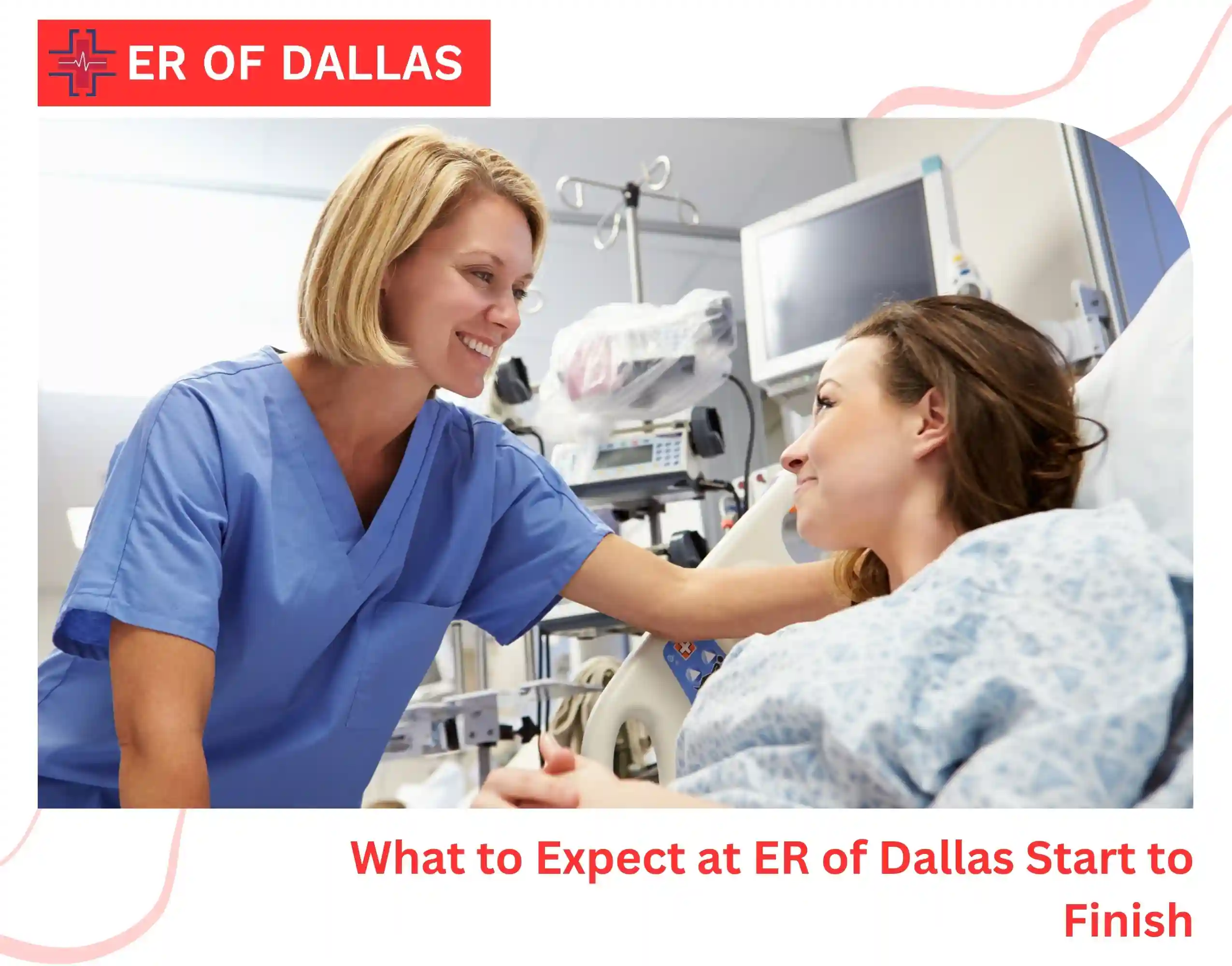
Here’s the full visit experience at ER of Dallas:
Arrival
Walk in. No appointment. Quick check-in and triage within minutes.
Evaluation
Roomed quickly. Board-certified ER physician evaluates you in person.
Diagnostics
On-site CT, X-ray, ultrasound, lab — done in-house with rapid turnaround.
Treatment
Whatever you need: IV medications, breathing treatments, stitches, splints, anti-nausea, pain control.
Discharge
Written instructions, prescriptions, follow-up referrals. Most visits last 1–3 hours total.
Transfer (rare)
For cases that need hospital admission, we stabilize you and coordinate transfer directly.
Insurance and Billing for Fast ER Care
Some patients hesitate to choose an ER because they’re worried about cost. Here’s the straight answer:
ER of Dallas accepts most major insurance plans. Under the federal No Surprises Act, your insurance is required to process emergency visits at your in-network benefit level — meaning your copay, deductible, and out-of-pocket responsibility are calculated the same way they would be at a hospital ER. We verify your benefits during your visit. We do not accept Medicare, Medicaid, CHIP, or TRICARE.
See our Insurance & Billing page for full details.
Frequently Asked Questions
(Implement FAQPage schema on this section)
Q: How fast is “fast” at ER of Dallas?
A: Most patients are roomed within 10 minutes of walking in. Many are roomed within 5. A board-certified emergency physician typically evaluates you within minutes of being roomed. The total visit length depends on what you need — most visits last 1 to 3 hours total.
Q: Is there ever a wait at ER of Dallas?
A: Rarely, brief waits can happen when multiple patients arrive at once. But you’ll be triaged immediately, and we don’t typically see the hours-long waits that hospital ERs do.
Q: How is ER of Dallas faster than a hospital ER?
A: Structurally. We don’t take ambulance triage queues, we don’t board admitted patients, our CT and lab serve only ER patients (no hospital-wide queue), and we don’t depend on inpatient specialist consults. It’s not that we’re trying harder — it’s that the bottlenecks simply don’t exist.
Q: Are you faster than urgent care?
A: Comparable on wait time — but with full ER capability (CT, ultrasound, IV medications, 24/7 hours) that urgent care doesn’t have. If your issue needs imaging or IV treatment, we’re faster overall because you don’t have to be referred onward.
Q: Should I come to you or call 911?
A: Call 911 for: unconscious or unresponsive patients, suspected stroke (BE FAST symptoms), severe trauma, severe bleeding, or anyone who can’t safely be transported by car. For everything else, walking into ER of Dallas is typically faster than waiting for an ambulance to a crowded hospital ER.
Q: Do I need an appointment?
A: No. ER of Dallas is a 24/7 walk-in emergency room. Just come in, or call +1 214-613-6694 to let us know you’re on the way.
Q: Will my insurance cover an ER visit?
A: Under the federal No Surprises Act, your insurance is required to process emergency visits at your in-network benefit level. We accept most major insurance plans. We don’t accept Medicare, Medicaid, CHIP, or TRICARE.
Q: Where is ER of Dallas located?
A: 4535 Frankford Rd, Dallas, TX 75287 — in Far North Dallas, minutes from Carrollton, Addison, Plano, and Frisco. Open 24/7. Call +1 214-613-6694.
Stop Waiting Hours. Walk In.
The reason most people delay going to an ER isn’t denial about how they’re feeling — it’s dread about the wait. We get it. We built our entire facility around eliminating that wait, with the same emergency capability you’d expect from a hospital ER. Board-certified emergency physicians, on-site imaging and lab, full IV medications, private rooms, and a team that sees you within minutes of walking in.
ER of Dallas is open 24/7 at 4535 Frankford Rd. Walk in or call ahead.
📍 Address: 4535 Frankford Rd, Dallas, TX 75287
📞 Phone: +1 214-613-6694
🕐 Hours: Open 24/7, every day, every holiday
🌐 Website: https://erofdallastx.com/


