

- Medically Reviewed by ER of Dallas Medical Team
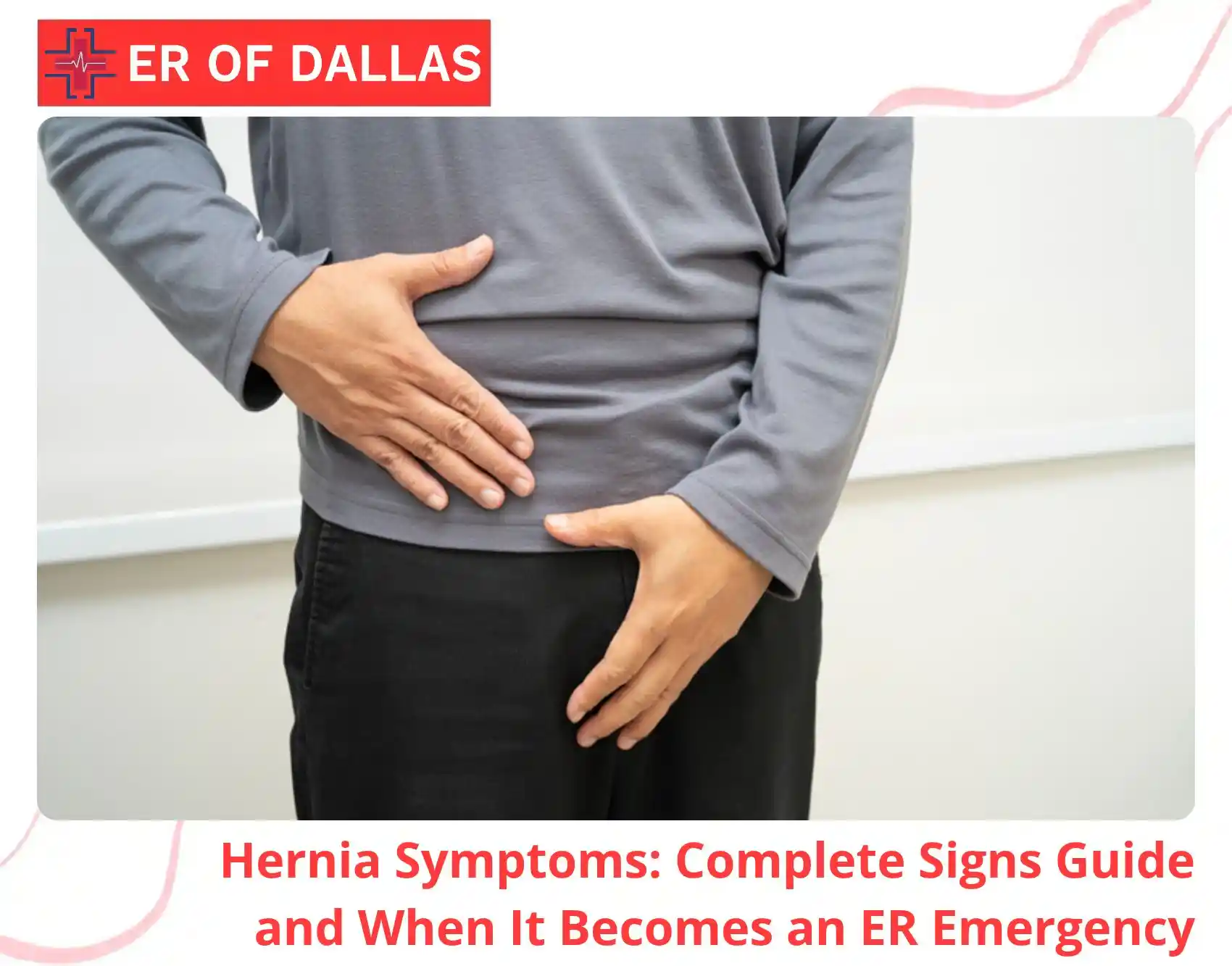
Hernia symptoms range from a painless bulge you can push back in to a rock-hard knot and vomiting that signals tissue death within hours. Understanding the full spectrum of warning signs is the difference between a scheduled surgical consult on Monday and an emergency transfer tonight. Below you will find the six common hernia locations, the three danger states a hernia can enter, and the specific signs that mean drive to ER of Dallas or call 911 instead of waiting.
Not every hernia is an emergency, but every hernia can become one. If you felt a new bulge, read the sections on strangulation and incarceration before anything else. Those two words are the ones that matter most for your next 24 hours.
What Are Hernia Symptoms? The Short List You Can Act On
The most common signs are a visible or palpable bulge, aching or dragging sensation in the affected area, pressure that worsens when you cough or lift, and tenderness that improves when you lie down. Severe or emergency warning signs include rock-hard bulge, color change, vomiting, and inability to pass stool.
A hernia is weakened muscle or connective tissue that lets abdominal contents push through. Where the weakness sits decides the symptoms, risks, and timing. Six locations account for almost all hernias we evaluate.
If your main concern is lower-side abdominal discomfort that may or may not be a hernia, our about ER of Dallas and our emergency capabilities covers how our physicians evaluate abdominal and groin presentations like hernia.
Signs by Hernia Type: The Six Locations You Need to Know

Hernias form at six predictable weak points in the abdominal wall and diaphragm. Each type carries its own symptom signature, risk profile, and typical patient demographic. Recognizing which type you may have narrows the emergency decision immediately.
| Hernia Type | Location | Most Affected | Visible Bulge? | Strangulation Risk |
| Inguinal | Groin crease | Men (75% of all hernias) | Yes | Moderate |
| Femoral | Upper inner thigh | Women | Yes (small) | HIGH |
| Umbilical | Belly button | Infants, post-pregnancy | Yes | Moderate |
| Hiatal | Diaphragm | Adults over 50 | No (internal) | Low |
| Incisional | Surgical scar | Prior-surgery patients | Yes | Moderate |
| Epigastric | Upper midline | Any adult | Small | Low |
Inguinal Hernia (Groin). The most common type, accounting for about 75 percent of all hernias. More frequent in men. Bulge sits in the groin crease, sometimes extending into the scrotum. Aching worsens with coughing, lifting, or long standing. Often feels better lying flat.
Femoral Hernia (Upper Thigh). Less common but higher risk. More frequent in women. Bulge sits just below the groin crease in the upper inner thigh. Femoral hernias strangulate at a much higher rate than inguinal, so even a small femoral bulge warrants prompt evaluation.
Umbilical Hernia (Belly Button). Common in newborns and in adults after pregnancy or significant weight gain. Bulge sits at or near the navel. Usually soft and reducible. Adult umbilical hernias tend to enlarge over time and can incarcerate.
Hiatal Hernia (Stomach Through Diaphragm). The only type with no visible bulge. Symptoms are chest or upper-belly burning, acid reflux that resists lifestyle changes, difficulty swallowing, and sometimes chest pain that mimics cardiac symptoms. A large paraesophageal hiatal hernia is a surgical case.
Incisional Hernia (Through a Prior Surgical Scar). Develops months to years after abdominal surgery at the healed incision. Bulge appears along the scar line, often enlarging with activity. Higher risk in patients with obesity, diabetes, or prior wound infection.
Epigastric Hernia (Upper Midline Belly). Small bulge in the midline between navel and breastbone. Often painless but can cause sharp pain when fat pinches through. Common in adults with abdominal strain history.
The Three Hernia Danger States: Reducible, Incarcerated, Strangulated
Every hernia exists in one of three states. Understanding which state yours is in decides whether you book a surgical consult, come to the ER today, or call 911 right now. The state can change within hours, which is why any new bulge deserves attention the moment it appears.
State 1: Reducible (Routine). You can push the bulge back in with gentle pressure while lying down, or it goes back on its own. Pain is mild and improves when you rest. This is the safe-for-now state. Schedule a surgical consult within 1 to 2 weeks.
State 2: Incarcerated (Urgent). The bulge is stuck and will not reduce no matter how you position yourself. Pain is constant and worsening. Nausea may begin. The trapped tissue still has blood supply, but if it loses that supply the state becomes strangulation. Come to the ER within hours.
State 3: Strangulated (Emergency). The trapped tissue has lost its blood supply and is dying. Bulge becomes rock-hard, exquisitely tender, and may turn red, purple, or dusky. Vomiting, fever, rapid heart rate, and inability to pass gas or stool appear. This is a surgical emergency measured in hours, not days. Call 911 or come in now.
The Cleveland Clinic hernia overview confirms this three-state progression and lists strangulation mortality rates that rise sharply after 6 hours of lost blood supply. The timing window for emergency surgical repair is narrow.??
The step between state 2 and state 3 is the critical one. For the acute conditions we handle alongside hernia emergencies, see our emergency services overview.
When Hernia Symptoms Become an ER Emergency

Any pattern that includes rock-hard bulge, vomiting, inability to pass gas or stool, fever, color change at the site, or pain that will not let you stand straight requires immediate ER evaluation. These point to strangulation, bowel obstruction, or both, and both conditions are measured in hours.
Specific emergency warning signs:
- Bulge that will not push back in no matter how you position yourself
- Pain at the bulge that is sudden, severe, or constant
- Vomiting, especially if the vomit is dark green or looks like coffee grounds
- Inability to pass gas or stool for more than 12 hours
- Skin over the bulge that turns red, purple, blue, or gray
- Rapid heart rate, fever over 101, or chills
- Abdominal swelling that is new and worsening alongside the bulge
For context on which vomiting patterns signal an abdominal emergency, our contact our ER team to ask whether what you are feeling needs immediate evaluation. Vomiting patterns can signal bowel obstruction, the complication strangulated hernias most commonly cause.
What ER of Dallas Does for Emergency Hernia Cases
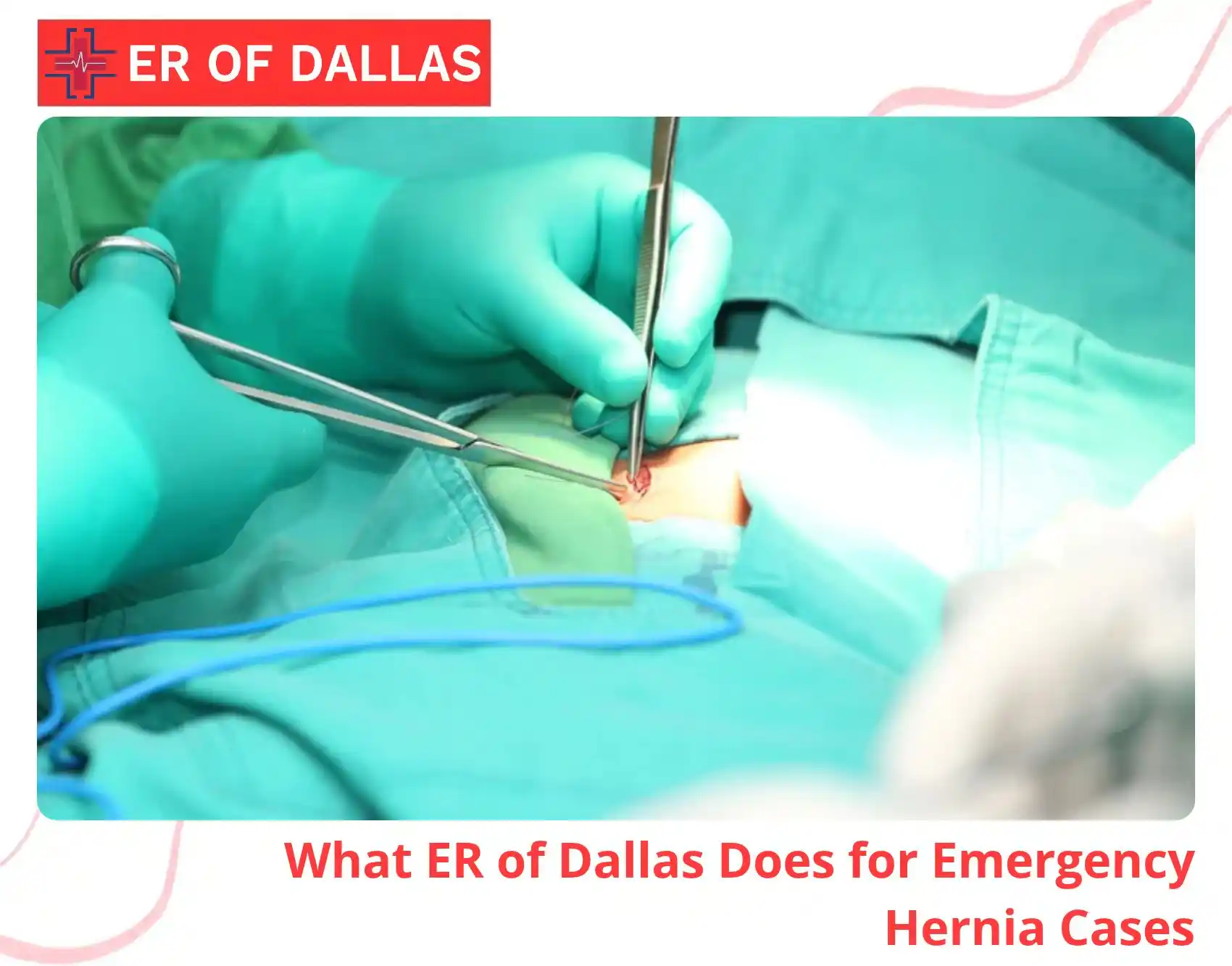
ER of Dallas provides rapid diagnosis, imaging, IV fluids, pain control, and stabilization for suspected incarcerated or strangulated hernias. We identify which cases need operating room care and coordinate direct transfer to a surgical facility under physician-to-physician handoff. Hernia repair itself is a scheduled or acute surgical procedure, not an ER procedure.
Our standard emergency hernia workup:
- Focused exam: bulge location, reducibility, skin color, bowel sounds, abdominal tenderness, and vital signs.
- Imaging as needed: ultrasound for soft-tissue assessment, CT scan for suspected strangulation, bowel obstruction, or atypical location.
- Lab work: complete blood count, metabolic panel, lactate for ischemia risk, and urinalysis to rule out other causes.
- Stabilization: IV fluids, pain management, and anti-nausea support where indicated.
- Surgical coordination: for incarcerated or strangulated cases, direct transfer under warm handoff. For stable reducible hernias, discharge with a surgical referral and clear return-precaution instructions.
Our no-wait ER model means the room is ready before you sign in. For a strangulated hernia where the clock has already started, that difference can change the surgical outcome.
Who Is at Higher Risk for Hernia Complications
Hernias form in weak tissue and grow under pressure. Prior abdominal surgery, chronic cough, chronic straining, pregnancy, and obesity all raise baseline risk. Strangulation risk is highest for femoral hernias and for small-defect hernias of any type.
According to Mayo Clinic guidance on inguinal hernia causes and risk factors, small hernia defects paradoxically carry higher strangulation risk than large ones because the tight opening is more likely to cut off blood supply to the trapped tissue.??
Risk factors that raise your threshold for coming in:
- Prior abdominal or pelvic surgery
- Chronic cough from smoking, asthma, or lung disease
- Chronic straining from constipation or heavy lifting
- Pregnancy or recent delivery
- Prior hernia repair on either side
- Age over 50
If one or more risk factors apply to you and you notice a new bulge, know where to go before it becomes urgent. See our ER near me resource to find drive-time from your area.
Frequently Asked Questions
Q: Can hernia symptoms appear suddenly without warning?
A: Yes. A sudden sharp pain with a new bulge during lifting, coughing, or straining is a classic acute hernia presentation. The hernia was there before as a weak spot but became symptomatic the moment tissue pushed through.
Q: Are hernia signs different in men and women?
A: Inguinal hernias are more common in men and often present with a visible groin bulge. Femoral hernias are more common in women and present with vague upper-thigh discomfort, which delays diagnosis and raises strangulation risk.
Q: Can I push a hernia back in myself?
A: Only if it is reducible, you are lying down, and the pressure is gentle and painless. Never force a bulge back if it is tender or hard. That maneuver can push ischemic tissue into the abdomen and worsen the emergency.
Q: Does a hiatal hernia require ER care?
A: Usually not. Hiatal hernias present with reflux and chest burning that respond to dietary changes and medication. Come in for acute chest pain you cannot distinguish from cardiac symptoms, vomiting blood, or severe swallowing difficulty.
Q: How quickly can a hernia escalate to emergency?
A: Incarceration can happen within minutes during a strain. Strangulation typically follows within 6 to 12 hours after incarceration. Once strangulation starts, tissue death begins within another 2 to 6 hours.
When in Doubt About a New Bulge, Come In
A mild bulge can wait for a surgical consult. Signs at the severe end are measured in hours of viable tissue. Only a hands-on exam can tell which you have. If any emergency warning signs apply, do not wait.
ER of Dallas is open 24 hours at 4535 Frankford Road, Dallas, TX 75287. Visit ER of Dallas for facility details and insurance information. Phone +1 214-613-6694. Walk in anytime, no appointment needed.


