

Appendicitis Emergency Care in Dallas, TX
Appendicitis can turn from a dull ache into a surgical emergency within a day. Once symptoms begin, the appendix can rupture in 24 to 72 hours, so fast diagnosis protects you. Our appendicitis emergency room in Dallas runs onsite CT imaging and lab work the moment you arrive, with results in minutes.
No appointment. No long wait. If pain in your lower right abdomen is building, walk in or call now.
Call Now: (214) 613-6694
Hours: 24/7/365
Walk-In: 4535 Frankford Rd, Dallas, TX, 75287
Could This Be Appendicitis?

Appendicitis usually begins as a vague ache near the belly button that settles into sharp pain in the lower right abdomen over several hours. The pain stays constant, worsens with movement, and often arrives with nausea and a lost appetite.
Common appendicitis symptoms include:
- Migrating pain that starts near the navel and shifts to the lower right side
- A constant ache that intensifies rather than coming in waves
- Nausea, sometimes with one or two episodes of vomiting
- Loss of appetite, even after hours without food
- Low-grade fever
- Sharper pain when you walk, cough, or press on the area
What sets appendix pain apart from ordinary stomach trouble is its steadiness. Gas and cramping ease and move around. Appendicitis settles in one spot and grows. If you want to understand what appendix pain feels like at each stage, our guide walks through the full progression.
When Appendicitis Becomes an Emergency
Appendicitis is always a reason to seek care, but knowing when to go to ER for appendicitis protects you from a rupture. The signs of a burst appendix, or of one about to burst, mean you need an appendicitis emergency room immediately, because infection spreads through the abdomen within hours and becomes far more dangerous to treat.
Go to the ER right away if you notice:
- Sudden, severe pain across the whole abdomen
- A rigid or hard belly that hurts to touch
- High fever with chills
- Rapid heartbeat or breathing
- Vomiting that won’t stop
One warning deserves special attention. If intense pain suddenly eases, do not assume you are improving. Sharp relief can mean the appendix has ruptured and the pressure has released. The signs of a burst appendix usually follow within hours, so treat sudden relief as a reason to come in, not a reason to wait.

What Happens When You Arrive
Your visit begins the moment you walk in, with no waiting while the pain builds. Because appendicitis moves quickly, we work to confirm or rule it out fast.
Within minutes of arrival:
Triage and Vitals
We check your pain, temperature, heart rate, and blood pressure, and ask when symptoms began.
Blood Work
Lab tests look for the elevated white blood cell count that points to infection.
CT Imaging
An onsite CT scan of the abdomen confirms appendicitis and shows whether the appendix has ruptured. Results come back in minutes.
IV Fluids and Comfort
We start fluids to keep you stable and ease nausea and pain.
Physician Evaluation
A board-certified emergency physician reviews everything, confirms the diagnosis, and explains the next step.
Appendicitis treatment centers on removing the appendix before it ruptures. We diagnose the condition, stabilize you, and coordinate your surgical care directly, so you move from diagnosis to treatment without losing time. If the appendix has already burst, we begin antibiotics and arrange urgent surgical care.
Everything happens under one roof. You are not sent across town for imaging while in pain.
Why a CT Scan Is the Deciding Test to Diagnose Appendicitis
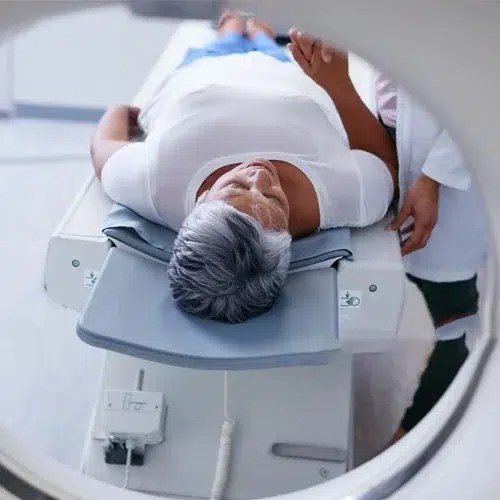
A CT scan of the abdomen is the most accurate way to diagnose appendicitis, and it removes the guesswork that delays treatment. It confirms the inflammation, measures its severity, and reveals whether the appendix has ruptured.
This matters because appendicitis does not always present clearly. Early symptoms can mimic gas, a stomach bug, or a kidney problem. Pressing on the abdomen and reviewing symptoms can raise suspicion, but only imaging confirms it. At our appendicitis emergency room, onsite CT means you get that answer during your visit rather than after a referral and a wait of several days.
For borderline cases, that certainty is the difference between watchful waiting at home and catching a rupture before it happens.
Appendicitis Symptoms in Women
Appendicitis is harder to recognize in women, and that difficulty causes dangerous delays. The appendix can sit higher or more centrally in the female pelvis, so the pain does not always land in the classic lower right spot.
Several conditions overlap with appendicitis in women, including ovarian cysts, pelvic infections, and urinary tract infections. Because the symptoms look alike, women are more often sent home from a first evaluation than men, only to return once the appendix worsens.
The distinguishing clues: pain that has built steadily over several hours, is not tied to your menstrual cycle, and comes with nausea or loss of appetite. If right-sided or lower abdominal pain fits that pattern, imaging settles the question fast. We use CT and ultrasound to separate appendicitis from gynecological causes, so you are not sent home guessing.

Conditions That Mimic Appendicitis

Several conditions cause pain that resembles appendicitis, which is why accurate diagnosis matters before any treatment. Our testing tells them apart.
- Ovarian cysts and pelvic conditions, which can mirror lower right pain in women
- Kidney stones or a kidney infection, where pain often spreads to the back
- Gastroenteritis, which brings cramping alongside diarrhea
- Constipation and trapped gas, which ease and shift rather than staying fixed
- Other causes of abdominal pain that need their own evaluation
Each of these calls for a different response. Onsite labs and imaging let our physicians find the real cause quickly instead of treating the wrong problem.
Why Choose ER of Dallas for Appendicitis Care
Answers in Minutes
Onsite CT and lab testing confirm or rule out appendicitis in a single visit, with no referral and no days-long wait.
Minimal Wait Times
Most patients reach an exam room within minutes, which counts when the appendix is on a clock.
Board-Certified Emergency Physicians
Our doctors distinguish appendicitis from the many conditions that imitate it, then act fast.
Direct Surgical Coordination
Appendicitis treatment is time-sensitive, so if you need an appendectomy, we arrange it without delay and move you straight from diagnosis to surgery.
Care That Fits Your Budget
We accept most major insurance plans and offer flexible payment plans, so cost never becomes a reason to delay emergency care.
Appendicitis Care Near You in Dallas
Searching for an appendicitis emergency room near you? ER of Dallas provides 24/7 emergency care with onsite CT imaging and lab testing across the metroplex.
We treat patients from:
- North Dallas
- Plano
- Richardson
- Garland
- Addison
- Carrollton
- University Park
- Highland Park
- Farmers Branch
- Irving and surrounding communities
No appointment. No excessive wait. Just fast answers when pain in your lower right side won’t let up.

Don't Wait Out Appendix Pain

Appendicitis rarely resolves on its own, and the longer it goes untreated, the more dangerous it becomes. What starts as a manageable ache can become a ruptured appendix within a day.
If pain in your lower right abdomen is steady and getting worse, our appendicitis emergency room can check it fast. Walk in or call ahead, and we will move quickly to find the cause.
Call Now:??(214) 613-6694
Hours: 24/7/365
Walk-In:??4535 Frankford Rd, Dallas, TX, 75287
FAQs
Can appendicitis go away on its own?
Rarely. Appendicitis usually worsens until the appendix ruptures. Some mild cases settle briefly, but the risk of a sudden, dangerous turn is high. Steady lower right abdominal pain needs prompt evaluation rather than waiting.
How long before an inflamed appendix bursts?
The appendix can rupture within 24 to 72 hours of the first symptoms, though timing varies. Because you cannot predict the window, sharp or worsening lower right pain calls for same-day care.
What's the difference between gas pain and appendicitis?
Gas pain shifts around and comes in waves, easing on its own. Appendicitis settles in the lower right abdomen, stays constant, and grows worse with movement, usually with nausea and lost appetite.
Will I need a CT scan or an ultrasound?
Most adults receive a CT scan, the most accurate test for appendicitis. Ultrasound is often used for children and during pregnancy. Our onsite imaging delivers results in minutes either way.
What happens if my appendix has already burst?
We start IV antibiotics and fluids immediately and coordinate urgent surgical care. A ruptured appendix spreads infection, so fast treatment is critical to prevent complications like peritonitis or sepsis.
How soon can I recover after appendix surgery?
Most people recover within one to two weeks when the appendix is removed before it ruptures. Recovery takes longer if it has burst, though rest and antibiotics support a full return.